
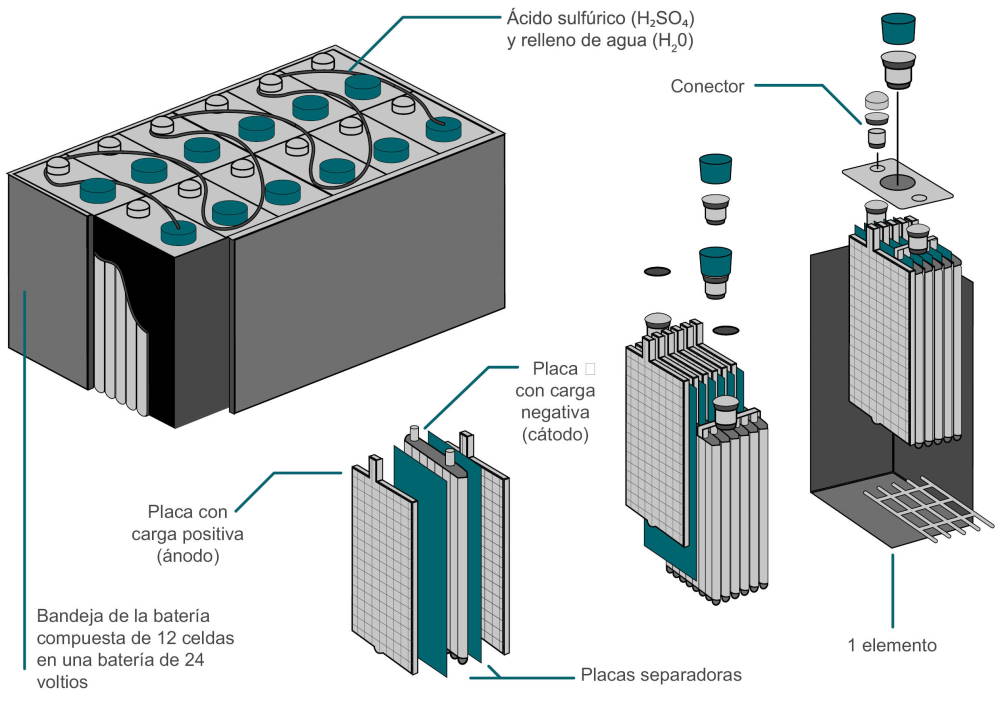
To know well the operation of batteries in forklift trucks it is necessary to take into account several aspects. And one of them is to know the structure of the batteries for forklift trucks, and thanks to know its internal structure we will be able to know better its operation and with it to be able to take the maximum advantage and to lengthen the useful life of the battery.
In this sense, one of the first things to take into account when analyzing the internal structure of batteries is that they work with galvanic elements where the conductors are electrically separated. But there is more. We explain it to you below.
Different parts that make up the structure of forklift truck batteries
As mentioned above, electric batteries are galvanic elements containing electrically separated conductors. This is where one of the most important parts of the forklift battery structure comes into play: the individual cells connected in parallel.
Each consists of a negatively charged cathode (negative pole) made of metal oxide. It also includes a positively charged anode (positive pole) made of metallic material, as well as an electrolyte and a separation plate (separator).
What is the function of each of the components that make up the battery structure?

All these elements that make up the structure of a forklift truck battery are involved in the chemical process of electrolysis, a process that is essential for the production of electrical energy inside the battery. For this process to occur, negatively charged electrons must flow from the cathode to the anode.
Before reaching the anode, the electrons pass through separators. These separators are permeable to ions but are not electrically conductive. Thus, these separators, which form the structure of the batteries, are responsible for ensuring that the battery cells are not short-circuited. It should be noted that during this discharge process the cell voltage is reduced due to the decrease of acid in the batteries.
With all this, we must not forget that to recharge a battery it is necessary that there is direct current. To obtain this type of energy is the battery charger, which consumes alternating current from the mains and transforms it into direct current adapted to the voltage of the battery.
This is a process during which electrical energy is transformed into chemical energy. This requires that electrons are released from the anode during the process. This restores the original charge gradient and the density of the battery acid increases again.
In order for battery technology to achieve the nominal voltage required for the operation of industrial trucks, several battery cells are connected in series to form the principle of a traction battery.


