Contenido
PARALLEL connection
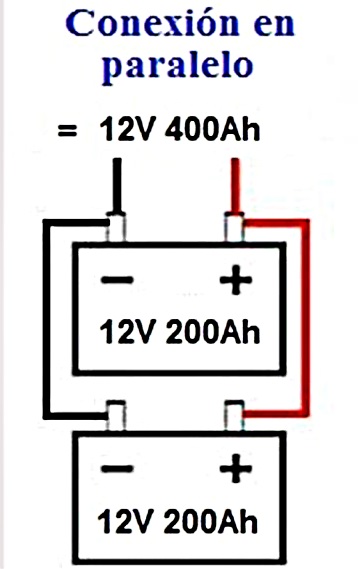
The parallel connection of two equal batteries allows to obtain an output twice the capacity of the individual batteries, maintaining the same nominal voltage.
Following this example, where we have two batteries of 200Ah and 12V each, connected in parallel, we will have:
– Total rated voltage: 12V (Volts).
– Total capacity: 400Ah (amperes per hour).
Capacity identifies the maximum amount of cargo that can be stored. The higher the capacity, the greater the amount of charge that can be stored. It is measured in Amperes per hour.
In this case, it means that with a capacity of 400Ah, the sum of both batteries can theoretically provide a current of 400 amps for 1 hour of time, or 200 amps for 2 hours continuously, or 100 amps for 4 hours continuously, and so on.
The lower the maximum current used (amperes), the longer the life of the batteries.
SERIAL connection
 Following this example in which we have two batteries of 200Ah and 12V each, connected in series, we will have:
– Total output voltage value: 24V (volts)
– Total capacity: 200Ah (amperes per hour), unchanged.
In this case, the higher the DC voltage to charge the batteries, the lower the losses along the cables.
SERIAL-PARALLEL connection

The combination of the parallel connection with the series connection will be a doubling of the rated voltage and capacity. Following this example, we will have two sets at 24V and 200Ah joined in parallel, thus forming a total of 24V and 400Ah.
When the link is important, pay attention to polarity, using wires of suitable section and as short as possible. The shorter the length of the connections, the lower the resistance formed in the wires for the passage of current, and therefore the lower the energy loss in the same.
SEE THE FULL RANGE OF BATTERIES AND ACCESSORIES
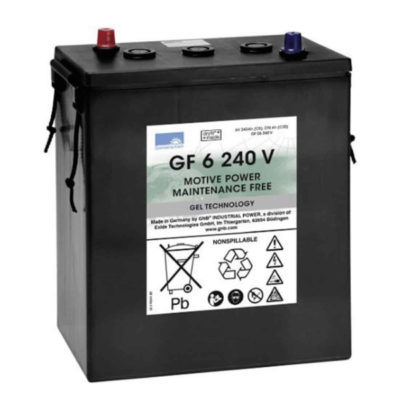
Sonnenschein GF06240V Gel 6V 270Ah Battery
619.52€ IVA incl.
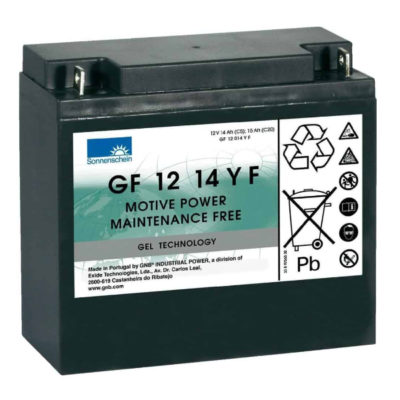
Sonnenschein GF12014YF 12V 15Ah Gel Battery
164.56€ IVA incl.